Introduction
I remember the moment clearly. I was standing on the soft sand of Koh Pha Ngan, my bare feet touching the earth, yet inside something felt unstable. A quiet tremor. Not dramatic, but enough to tell me: my foundation was shifting.
That foundation is the root chakra. It sits deep within you, the energetic roots of your being. When it is strong, you feel safe, grounded, confident. When it falters, fear, insecurity, restlessness creep in. And your adrenal glands, legs, feet, bones all begin to whisper that you’ve lost footing.
In this article, I’ll walk you through what the root chakra is, how fear weakens it, how it connects to your adrenal glands, and practical steps you can use to restore balance, safety and stability. If you feel unsteady, this is for you.
When the root chakra is strong, we feel safe, grounded, confident — in short, we experience a balanced root chakra that supports our entire being.

Root Chakra in Depth
Root Chakra – The Foundation of Your Energy
The term “root chakra” comes from the Sanskrit word Muladhara (mula = root, adhara = support or base).
This chakra is located in the perineum (between the genitals and the anus) and often symbolised in a red or brown colour, pointing to its link with earth, stability and survival.
Physically, it relates to your legs, feet, toes, skin, bones and blood – all the parts of you that touch ground and support your structure. Emotionally, it anchors your sense of safety, belonging, survival.
When this muladhara chakra is aligned, you feel grounded, safe to take your seat in life. When it is out of balance, you might feel unrooted, restless, fearful that leads to anxiety. It’s the energetic basement of your body‑mind system.
What Is the Root Chakra and Why It Matters
If you’ve ever asked yourself what is the muladhara chakra, you’re not alone. This energy center is often misunderstood — seen as something basic or “lower,” when in truth, it holds the very ground of your being.
The root chakra, or Muladhara, is the first of the seven primary energy centers in your subtle body. “Mula” means root, and “adhara” means support or base. Located in the perineum, it’s the energetic foundation that anchors your spiritual and physical self to the Earth.
While some associate higher chakras with awakening or insight, the muladhara chakra is where awakening begins. Without safety, without ground, we cannot rise. Just like a tree cannot grow upward without deep roots, your energy cannot expand without being rooted.
This chakra is intimately connected to your body’s survival mechanisms — especially your adrenal glands, responsible for fight-or-flight responses. When your muladhara chakra is balanced, the adrenals function smoothly. You respond rather than react. You feel a natural confidence in your body, your instincts, and your life path.
But when this chakra is blocked, your system is stuck in alert mode. You may not feel safe even in safe environments. You might live in your head, disconnected from your body. You might rush through life trying to control outcomes — all because your inner foundation is shaky.
That’s why healing the root chakra is not just spiritual; it’s deeply physiological. It’s a return to presence. To belonging. To enoughness.
The muladhara chakra teaches us that grounding is not a passive state. It is an active relationship with the earth beneath your feet. It is choosing to trust, to root, to stay.
When you feel this energetic root system come online, you’re no longer just walking — you’re belonging. And that’s where real transformation begins.
How Fear Disrupts the Muladhara Chakra and the Adrenal Glands
We live in a world of continuous stress‑signals: fear of loss, fear of illness, fear of instability. These subtle fears don’t always shout “danger!” but they whisper through your nervous system.
Fear disconnects you from the muladhara chakra – you begin to live above ground instead of from your roots. That energetic disconnect echoes in the physical body. The muladhara chakra is closely connected to your adrenal glands (the endocrine organs that live atop your kidneys and respond to survival‑signals).
An over‑stimulated muladhara chakra/adrenal link may look like fatigue, dark circles under the eyes, restless nights, skin issues, weak legs or unstable knees. Over time you might feel financially insecure, emotionally unstable, unable to trust your body or your place in the world.
So, your adrenal glands react to fear. Your muladhara chakra absorbs that reaction into your energy body. If unaddressed, this cycle undermines the foundation of your being.
Signs Your Muladhara Chakra Needs Attention
Here are some common indicators you may need to work with your muladhara chakra:
Emotional: deep‑seated insecurity, fear of losing what you value, restlessness, inability to trust your body.
Physical: persistent issues in feet, legs, knees; skin or bone problems; adrenal fatigue symptoms; sense of disconnection from your body.
Energetic: feeling ungrounded when standing, inability to stay present in your body, or tapping out of your feet when you walk.
If you recognise more than one of these, it’s a signal: your foundation needs tending.
Symptoms of a Blocked Root Chakra
A blocked or unbalanced muladhara chakra can manifest in many subtle and not-so-subtle ways — emotionally, physically, and in the way we respond to life. These are some of the most common symptoms of a blocked muladhara chakra:
Emotional & Energetic Symptoms:
- Persistent fear or feeling unsafe without a clear reason
Deep insecurity, especially around money or survival
Feeling disconnected from your body or environment
Tendency to overthink or stay in your head
Avoidance of stillness or restlessness when still
Physical Symptoms:
Fatigue or adrenal burnout
Cold feet or poor circulation
Issues in the legs, knees, hips, or lower back
Skin problems, especially on lower body
Bone density issues or weak joints
Disrupted sleep, especially between 3–5 a.m.
Digestive discomfort (due to stress response)
Behavioral Patterns:
Hoarding or over-attachment to material things
Over-controlling or needing constant security
Avoidance of risk or discomfort
Feeling stuck or unable to move forward
Escaping into upper chakras (excess spiritual bypassing)
Noticing these signs isn’t about judgment — it’s about awareness. Your body and energy are always communicating. Listening is the first step to healing.
What the Root Chakra Wants from You
The muladhara chakra doesn’t demand grand spiritual feats. It asks three simple things: safety, stability, belonging.
It wants you to feel supported by your body, by your ground, by your very presence. It invites you to come home to yourself. To trust that you can stand, you can belong, you can be safe.
When you honour that invitation, you repair the foundation. You ask less “Am I safe?” and more “Can I trust that I am?” This shift changes everything.
Practical Grounding Techniques for Muladhara Chakra Healing
Here are grounded, accessible practices you can integrate today:
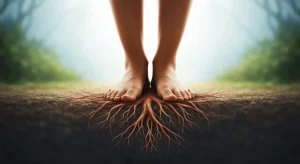
Quiet body‑aware rooting: stand or sit barefoot, feel contact with ground, visualise your roots stretching down.
Connection‑to‑feet practice: feel your feet, legs, bones, let them remind you of gravity, support, earth.
Visualise colour & element: invite red or brown light at perineum, flowing down your legs into earth.
Adrenal‑link meditation: imagine the adrenals atop the kidneys and energy strings connecting them to your root centre (perineum).
Mindful daily moment: when fear arises (news, conversation, self‑judgement) pause, exhale, imagine the fear draining into earth roots beneath you.
Movement + nature: walk barefoot on grass/sand, do yoga poses that ground (legs wide, feet rooted), work with your lower body to reinforce root energy.
And if you feel called to go deeper – I crafted a full step‑by‐step Root Chakra Grounding Meditation (with visuals and audio) that builds on these foundations. [Link here to your other post]
Why My Barefoot Story Matters
I once believed I was grounded simply because I walked barefoot every day on Koh Pha Ngan — until a stone underfoot opened a subtle truth. I felt pain, yes; but more importantly I realised: physical contact with earth doesn’t always equal energetic grounding.
That moment became a turning point. During a silent Vipassana retreat I asked: How do I root the energy body — not just the physical body? The answer reshaped my work.
You see, you can hug trees, walk barefoot, place your hands in soil — all good. But unless your energy body is aligned, your foundation remains fragile. The muladhara chakra is subtle. It’s less “feet on earth” and more “you belong to the earth”.
The Tree Analogy – From Feet to Foundations
Think of your body as a tree:
Your feet and legs are the roots.
Your hips and core become the trunk.
Your arms and head branch into the sky.
When the roots are weak, the entire tree sways. When the roots are firm and deep, the tree weathers storms, stands tall.
So it is with you: by strengthening your muladhara chakra, you fortify your entire system—from your bones up to your awareness.
Healing Over Time – What Shifts to Expect
With consistent practice you’ll notice subtle but deep changes:
Feet feel warmer, stronger; legs more stable.
You respond less to random fear triggers.
A quieter mind when the world pushes hard.
A growing sense of safety, rather than craving it.
Improved alignment in body and energy: fewer aches in hips/legs, calmer adrenal tone.
Remember: it’s not about perfection. It’s about steady rooting.
Integrating Into Daily Life
Grounding isn’t just a meditation—it’s weaving your sense of belonging into life.
While brushing your teeth: imagine your feet pressing into earth.
When walking: feel each heel strike, each toe‑push.
Before opening your phone/news: pause a moment, root your feet, centre your body.
At night: visualise roots releasing the day’s pressure into the earth.
The small moments make the difference. Your muladhara chakra is built one grounded breath at a time.
When to Seek Additional Support
If you’ve long‑term adrenal challenges, chronic fear, trauma or physical instability, your muladhara chakra work will benefit from additional support: body‑work, healing energy, somatic therapy.
My door remains open — if you feel stuck or in need of guided support, I offer one‑on‑one sessions to explore your root foundational healing together.
Conclusion
Your muladhara chakra is the energetic bedrock of your being. When you honor it, you honor your body, your nervous system, your sense of home—and your connection to life itself.
Fear may knock, the world may shake — but when you root consciously into the earth of your being, you stand. You breathe. You belong.
If you’d like to explore deeper, my full Root Chakra Grounding Meditation (step‑by‑step with audio) is linked above.
Thank you for walking this path with me.